Beyond COBOL: The 7 Invisible Legacy Technologies Still Running the World (And How AI Modernizes Them)
KEY TAKEAWAYS

  • Organizations are being squeezed between a failing infrastructure layer and an aging application layer, making the cost of "doing nothing" officially higher than the cost of modernization.
  • By combining the probabilistic power of LLMs with deterministic symbolic analysis, organizations can extract hidden business logic from ancient codebases with accuracy, reducing project timelines by 40% to 60%.
  • Migrating from brittle 32-bit monoliths to cloud-native microservices allows enterprises to redirect up to 80% of their IT budget from maintenance to new growth initiatives.

When people talk about legacy tech, they usually pivot immediately to COBOL. It’s the industry’s favorite boogeyman; the ancient code powering the global financial system, written by people who are now more likely to be found on a golf course than in a server room. But while COBOL gets the headlines, there is a much larger, much more dangerous invisible layer of technology holding your business hostage.

In 2026, the enterprise landscape is a tale of two cities. On one side, we have the rapid deployment of agentic AI. On the other, we have a massive foundation of software architectures from the 1990s that facilitate a staggering proportion of global economic activity. We call these the “Invisible Seven.” They aren't just old; they are reaching a state of terminal obsolescence.

If you are running mission-critical workflows on these platforms, you aren't just dealing with tech debt. You are sitting on a ticking time bomb. The talent has retired, the hardware is failing, and the security vulnerabilities are widening. But here’s the good news: the same AI that’s making headlines is now being used to perform deep-tissue surgery on these legacy systems.

The Existential Imperative: Why 2026 is the Year of No Return

For years, modernization was a discretionary IT project; something you’d get around to when the budget was flush. Those days are gone.

The primary catalyst is the final death rattle of Windows 10, which reached its official end-of-life in October 2025. If you’re still tethered to it for your legacy desktop apps, you’re now paying what is essentially a status quo tax in the form of Extended Security Updates (ESU). These costs are designed to be punitive. For a mid-sized organization, simply keeping the lights on for 200 legacy seats can exceed $200,000 a year; a budget that provides exactly zero incremental business value.

Beyond the financial penalty, there is the talent crisis. The people who built these systems are entering their 70s. When they leave, they take the manual with them, leaving you with a black box that runs your business, but which no one on your current team understands.

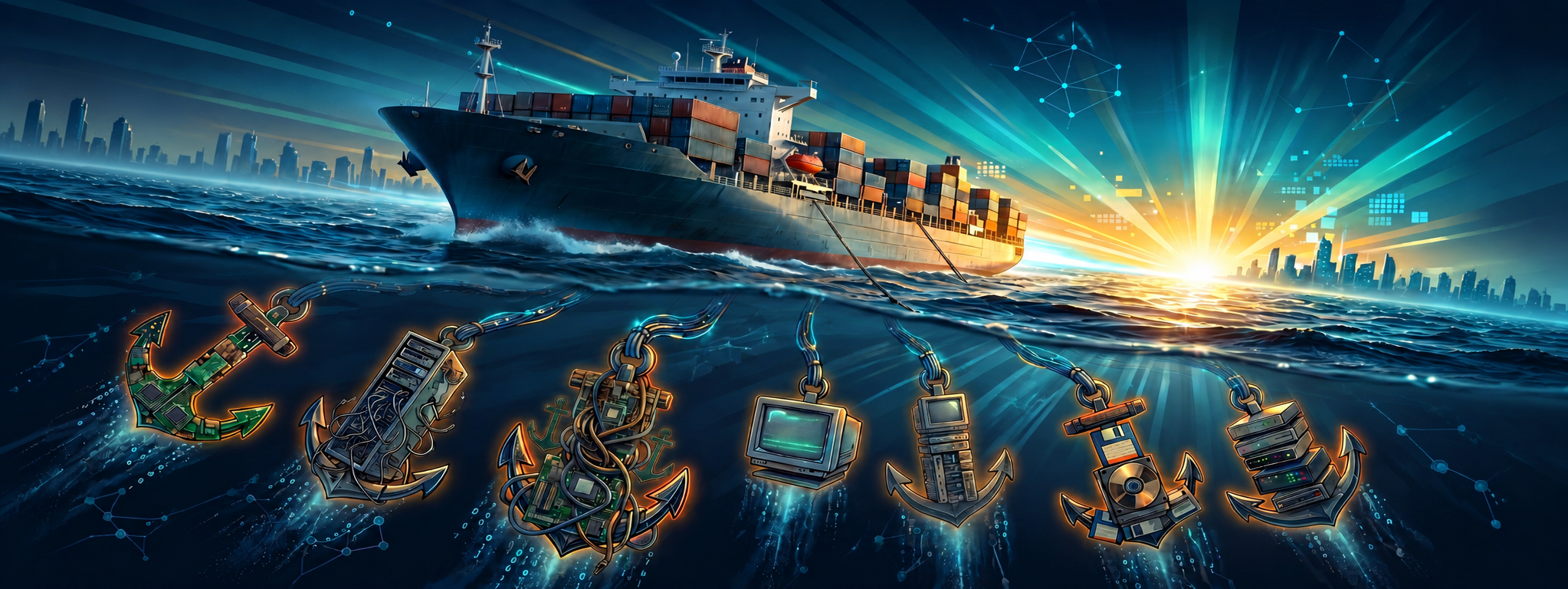
The Most Wanted List: The 7 Invisible Anchors

Let’s look at the technologies currently anchoring organizations to high-risk, 32-bit infrastructures.

1. Visual Basic 6.0 (VB6): The 32-Bit Ghost

VB6 is the ultimate citizen developer survivor. Twenty-eight years after its release, it’s still everywhere. It was incredibly productive for building departmental tools that eventually became mission-critical backbones.

The problem? It’s strictly 32-bit and operates on the Component Object Model (COM) architecture, which lacks modern session management. The real nightmare of a VB6 to .NET migration is logic fragmentation. Original developers often buried business rules directly into the UI event handlers. If you try to replace the interface without reverse-engineering that hidden logic, the whole thing fails.

2. PowerBuilder: The DataWindow Trap

In the 90s, PowerBuilder was the king of data-intensive client-server apps. Its DataWindow object was a stroke of genius for data manipulation, but that abstraction is now a modernization barrier.

Early versions (v10 and below) are unsupported and can’t run in 64-bit environments. Plus, the cost of PowerScript specialists has skyrocketed to $200+ per hour, if you can even find one. This leads to bit rot, where you can’t even apply critical security patches.

3. Visual FoxPro (VFP): The Sudden Failure Risk

FoxPro was prized for its local database engine and speed. Even though Microsoft killed support years ago, it still haunts manufacturing floors.

The risk here is sudden operational failure. A single Windows update can permanently break VFP’s ability to talk to printers or databases. Moreover, VFP lacks the encryption standards required for GDPR or HIPAA.

4. Lotus Notes (HCL Domino): The App Jungle

Lotus Notes is a document-oriented system that predates modern web standards. Many enterprises are struggling with an app jungle of thousands of NSF databases filled with proprietary Formula Language.

Migrating this is a nightmare because rich text fields often contain embedded OLE objects that don't map to modern platforms. It’s not just a data migration; it’s an archaeological dig.

5. Delphi: The Industrial Black Box

Delphi (Object Pascal) remains prominent in medical devices and industrial automation. While newer versions exist, a mountain of legacy Delphi 7 code remains in production.

The Delphi Dilemma is one of institutional knowledge. As original engineers retire, the complex memory management logic governing high-speed processes becomes a black box. You can't just rewrite this; the precision required for hardware interaction makes manual rewrites too risky.

6. RPG (IBM i / AS/400): The Resilient Monolith

RPG powers roughly 25% to 30% of U.S. manufacturing and distribution. It’s legendary for its uptime: eight nines of reliability.

The goal here isn't necessarily to kill the platform, but to move toward API-first thinking. You can use AI to expose legacy RPG logic as modern REST APIs so it can talk to the modern world.

7. ColdFusion: The Monolithic Trap

ColdFusion (CFML) is often considered the most modern of the legacy list because it runs on the Java Virtual Machine. However, most enterprise CF applications are monolithic and difficult to scale.

Because CFML makes it easy to mix business logic with presentation layers, these apps are tangled. You need a strategic redesign to make them cloud-ready.

Why Traditional Modernization Models Fail

Historically, you had two choices: a Greenfield Rewrite or a Lift-and-Shift. Both are usually bad ideas.

  • Greenfield Rewrites fail 80% of the time. Why? Because your old code is the only accurate documentation of your business rules. When developers try to rewrite from scratch, they miss the edge cases and historical patches that keep the business running.
  • Lift-and-Shift (Rehosting) solves nothing. You’re just moving your technical debt to someone else's computer without reducing maintenance costs or fixing the talent shortage.

The AI Modernization Paradigm: Neuro-Symbolic Refactoring

The breakthrough in 2026 is a move toward Neuro-Symbolic or Hybrid AI architectures . This combines the probabilistic power of Large Language Models (LLMs) with the deterministic rigor of symbolic logic.

Phase 1: Deterministic Code Comprehension

We start with symbolic analysis. Tools parse your legacy codebase into a knowledge graph. This captures every variable and dependency with accuracy. For the first time, your black box becomes transparent.

Phase 2: Logic Extraction and Translation

Once understood, the AI transitions to logic extraction. The symbolic engine identifies rule-dense areas, and the LLM translates those technical behaviors into business-readable rules. The symbolic system ensures the underlying logic remains mathematically identical to the original code.

Phase 3: Automated Safety Nets

In 2026, modernization is not a leap of faith. We use AI agents to auto-generate tests that capture the current behavior of the legacy system. Then, agentic swarms handle repetitive transformations at a scale human teams can't match, reducing project timelines by 40% to 60%.

The Innovation Dividend

The ultimate goal of modernization isn't just to have newer code; it's to unlock the Innovation Dividend. If you are spending 70-80% of your IT budget on legacy maintenance, you are structurally blocked from innovation. By moving to cloud-native microservices, you shift from fixed, high CapEx to variable, optimized OpEx. You go from quarterly deployments to weekly or daily ones, reducing infrastructure costs by 30-50%.

Future-Proofing Your Logic

The era of the "Invisible Seven" is ending. The 32-bit environment is dead, the developers are retiring, and your adversaries are weaponizing AI to find the holes in your aging infrastructure.

By treating legacy code as a source of structured, usable knowledge, you can migrate your technical debt into cloud-native intelligence. This is no longer a choice between a failed rewrite and a risky status quo; it’s a strategic move toward an architecture that is resilient and ready for the AI economy of 2030.

Stop Managing Decay. Start Driving Innovation.

Is your business being held hostage by a system no one understands? Don't wait for a sudden operational failure to force your hand. At MorelandConnect, we specialize in turning high-risk legacy anchors into cloud-native engines of growth.

Contact us today to see how our AI Orchestration platform can decode your technical debt and unlock your Innovation Dividend.

Beyond COBOL: The 7 Invisible Legacy Technologies Still Running the World (And How AI Modernizes Them)

KEY TAKEAWAYS

  • Organizations are being squeezed between a failing infrastructure layer and an aging application layer, making the cost of "doing nothing" officially higher than the cost of modernization.
  • By combining the probabilistic power of LLMs with deterministic symbolic analysis, organizations can extract hidden business logic from ancient codebases with accuracy, reducing project timelines by 40% to 60%.
  • Migrating from brittle 32-bit monoliths to cloud-native microservices allows enterprises to redirect up to 80% of their IT budget from maintenance to new growth initiatives.

When people talk about legacy tech, they usually pivot immediately to COBOL. It’s the industry’s favorite boogeyman; the ancient code powering the global financial system, written by people who are now more likely to be found on a golf course than in a server room. But while COBOL gets the headlines, there is a much larger, much more dangerous invisible layer of technology holding your business hostage.

In 2026, the enterprise landscape is a tale of two cities. On one side, we have the rapid deployment of agentic AI. On the other, we have a massive foundation of software architectures from the 1990s that facilitate a staggering proportion of global economic activity. We call these the “Invisible Seven.” They aren't just old; they are reaching a state of terminal obsolescence.

If you are running mission-critical workflows on these platforms, you aren't just dealing with tech debt. You are sitting on a ticking time bomb. The talent has retired, the hardware is failing, and the security vulnerabilities are widening. But here’s the good news: the same AI that’s making headlines is now being used to perform deep-tissue surgery on these legacy systems.

The Existential Imperative: Why 2026 is the Year of No Return

For years, modernization was a discretionary IT project; something you’d get around to when the budget was flush. Those days are gone.

The primary catalyst is the final death rattle of Windows 10, which reached its official end-of-life in October 2025. If you’re still tethered to it for your legacy desktop apps, you’re now paying what is essentially a status quo tax in the form of Extended Security Updates (ESU). These costs are designed to be punitive. For a mid-sized organization, simply keeping the lights on for 200 legacy seats can exceed $200,000 a year; a budget that provides exactly zero incremental business value.

Beyond the financial penalty, there is the talent crisis. The people who built these systems are entering their 70s. When they leave, they take the manual with them, leaving you with a black box that runs your business, but which no one on your current team understands.

The Most Wanted List: The 7 Invisible Anchors

Let’s look at the technologies currently anchoring organizations to high-risk, 32-bit infrastructures.

1. Visual Basic 6.0 (VB6): The 32-Bit Ghost

VB6 is the ultimate citizen developer survivor. Twenty-eight years after its release, it’s still everywhere. It was incredibly productive for building departmental tools that eventually became mission-critical backbones.

The problem? It’s strictly 32-bit and operates on the Component Object Model (COM) architecture, which lacks modern session management. The real nightmare of a VB6 to .NET migration is logic fragmentation. Original developers often buried business rules directly into the UI event handlers. If you try to replace the interface without reverse-engineering that hidden logic, the whole thing fails.

2. PowerBuilder: The DataWindow Trap

In the 90s, PowerBuilder was the king of data-intensive client-server apps. Its DataWindow object was a stroke of genius for data manipulation, but that abstraction is now a modernization barrier.

Early versions (v10 and below) are unsupported and can’t run in 64-bit environments. Plus, the cost of PowerScript specialists has skyrocketed to $200+ per hour, if you can even find one. This leads to bit rot, where you can’t even apply critical security patches.

3. Visual FoxPro (VFP): The Sudden Failure Risk

FoxPro was prized for its local database engine and speed. Even though Microsoft killed support years ago, it still haunts manufacturing floors.

The risk here is sudden operational failure. A single Windows update can permanently break VFP’s ability to talk to printers or databases. Moreover, VFP lacks the encryption standards required for GDPR or HIPAA.

4. Lotus Notes (HCL Domino): The App Jungle

Lotus Notes is a document-oriented system that predates modern web standards. Many enterprises are struggling with an app jungle of thousands of NSF databases filled with proprietary Formula Language.

Migrating this is a nightmare because rich text fields often contain embedded OLE objects that don't map to modern platforms. It’s not just a data migration; it’s an archaeological dig.

5. Delphi: The Industrial Black Box

Delphi (Object Pascal) remains prominent in medical devices and industrial automation. While newer versions exist, a mountain of legacy Delphi 7 code remains in production.

The Delphi Dilemma is one of institutional knowledge. As original engineers retire, the complex memory management logic governing high-speed processes becomes a black box. You can't just rewrite this; the precision required for hardware interaction makes manual rewrites too risky.

6. RPG (IBM i / AS/400): The Resilient Monolith

RPG powers roughly 25% to 30% of U.S. manufacturing and distribution. It’s legendary for its uptime: eight nines of reliability.

The goal here isn't necessarily to kill the platform, but to move toward API-first thinking. You can use AI to expose legacy RPG logic as modern REST APIs so it can talk to the modern world.

7. ColdFusion: The Monolithic Trap

ColdFusion (CFML) is often considered the most modern of the legacy list because it runs on the Java Virtual Machine. However, most enterprise CF applications are monolithic and difficult to scale.

Because CFML makes it easy to mix business logic with presentation layers, these apps are tangled. You need a strategic redesign to make them cloud-ready.

Why Traditional Modernization Models Fail

Historically, you had two choices: a Greenfield Rewrite or a Lift-and-Shift. Both are usually bad ideas.

  • Greenfield Rewrites fail 80% of the time. Why? Because your old code is the only accurate documentation of your business rules. When developers try to rewrite from scratch, they miss the edge cases and historical patches that keep the business running.
  • Lift-and-Shift (Rehosting) solves nothing. You’re just moving your technical debt to someone else's computer without reducing maintenance costs or fixing the talent shortage.

The AI Modernization Paradigm: Neuro-Symbolic Refactoring

The breakthrough in 2026 is a move toward Neuro-Symbolic or Hybrid AI architectures . This combines the probabilistic power of Large Language Models (LLMs) with the deterministic rigor of symbolic logic.

Phase 1: Deterministic Code Comprehension

We start with symbolic analysis. Tools parse your legacy codebase into a knowledge graph. This captures every variable and dependency with accuracy. For the first time, your black box becomes transparent.

Phase 2: Logic Extraction and Translation

Once understood, the AI transitions to logic extraction. The symbolic engine identifies rule-dense areas, and the LLM translates those technical behaviors into business-readable rules. The symbolic system ensures the underlying logic remains mathematically identical to the original code.

Phase 3: Automated Safety Nets

In 2026, modernization is not a leap of faith. We use AI agents to auto-generate tests that capture the current behavior of the legacy system. Then, agentic swarms handle repetitive transformations at a scale human teams can't match, reducing project timelines by 40% to 60%.

The Innovation Dividend

The ultimate goal of modernization isn't just to have newer code; it's to unlock the Innovation Dividend. If you are spending 70-80% of your IT budget on legacy maintenance, you are structurally blocked from innovation. By moving to cloud-native microservices, you shift from fixed, high CapEx to variable, optimized OpEx. You go from quarterly deployments to weekly or daily ones, reducing infrastructure costs by 30-50%.

Future-Proofing Your Logic

The era of the "Invisible Seven" is ending. The 32-bit environment is dead, the developers are retiring, and your adversaries are weaponizing AI to find the holes in your aging infrastructure.

By treating legacy code as a source of structured, usable knowledge, you can migrate your technical debt into cloud-native intelligence. This is no longer a choice between a failed rewrite and a risky status quo; it’s a strategic move toward an architecture that is resilient and ready for the AI economy of 2030.

Stop Managing Decay. Start Driving Innovation.

Is your business being held hostage by a system no one understands? Don't wait for a sudden operational failure to force your hand. At MorelandConnect, we specialize in turning high-risk legacy anchors into cloud-native engines of growth.

Contact us today to see how our AI Orchestration platform can decode your technical debt and unlock your Innovation Dividend.

Get the white paper
Fill out the email address to request your complimentary report.
Thank you! Your submission has been received!
Oops! Something went wrong while submitting the form.